A Brief Look at ALife
What is artificial life, also known as ALife? What applications does ALife provide?
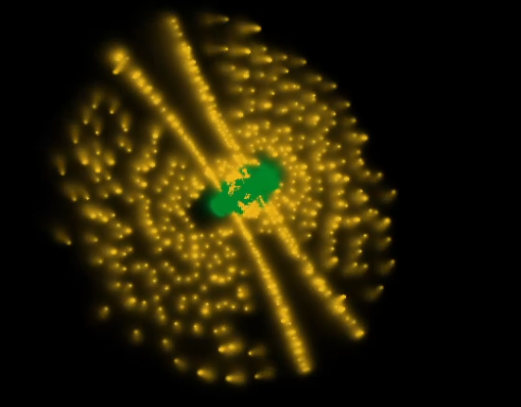
What is artificial life, also known as ALife? With its roots in the cybernetics of the 1940s, ALife is a rapidly expanding, multidisciplinary field that spans biology, chemistry, physics, computer science, and complexity science in order to understand the fundamentals of life itself. ALife as a field was named formally by Christopher Langton in 1986. Its first international conference was held in 1987.
Many scientists in the field take a constructionist approach to understanding life and life-like processes by attempting to model or build life and life-like behaviors, either in vitro or in silico.
ALife:
- Not only models known behaviors (flocking, swarming, mycelial growth) but asks “what if” - simulating imagined behaviors or forms; i.e. "Life as it could be."
- Embraces concepts of self-replication, adaptation, open-ended evolution, emergence, diverse intelligences.
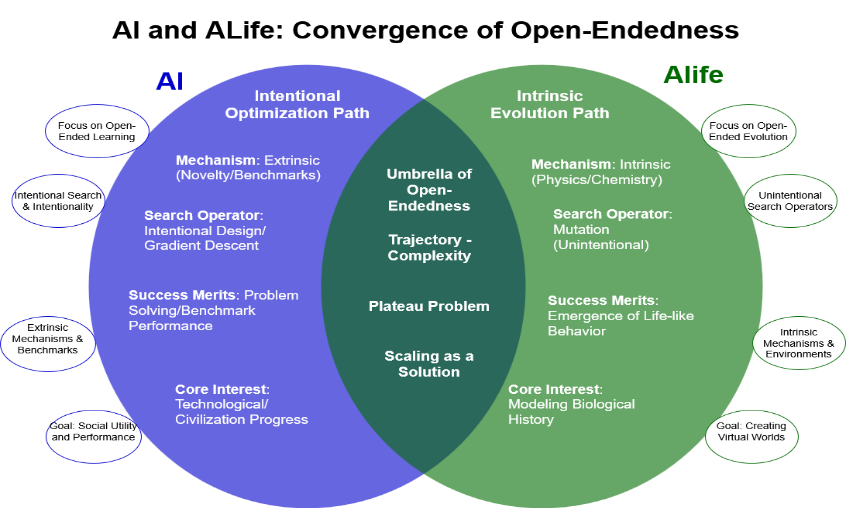
Open-ended evolution has been identified by many scientists in the field as its grand challenge. Evolution has produced novelty for billions of years, never running out of possibilities (even when it "recycles" modes for adaptive flight or swimming). Artificial systems (whether AI or ALife) always plateau, none so far has achieved the seemingly endless novelty of biological evolution. (From our perspective, at least. Is biological evolution inherently plateau-free, or have we not reached it?)
Here is a breakdown of how the fields of AI and ALife intersect on the question:
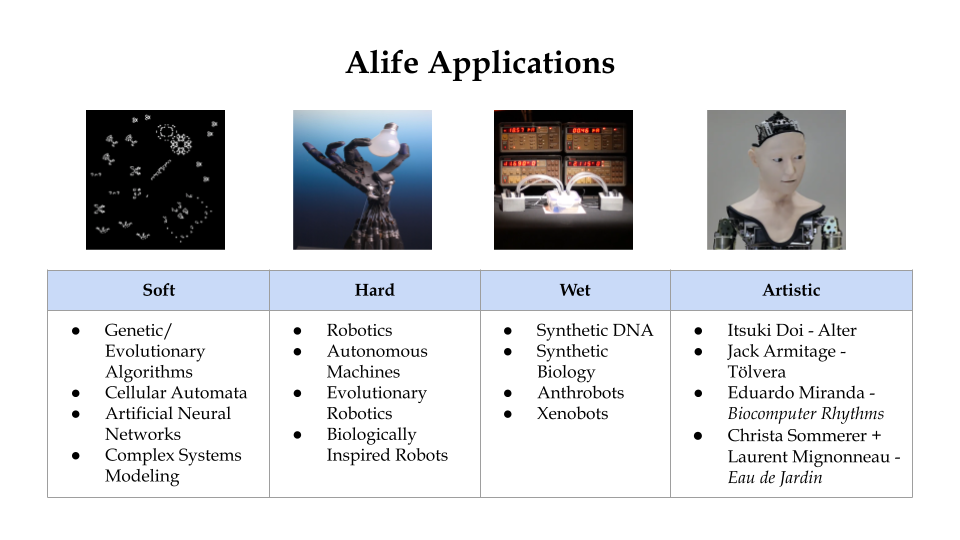
ALife has many applications in biomedicine, robotics, and has been embraced by visual artists for decades. Among musicians, there has been less widespread engagement, but some individuals have made notable contributions. More about that in on this page!
Some links for further reading:
A community-driven reference for ALife: https://alife.org/encyclopedia/
An ALife Expo with interactivity by Imran Khan: https://alife-expo.org/
Community for ALife educators: https://alife-edu.github.io/
Official publications of the International Society for ALife: https://direct.mit.edu/artl